New construction comes with a satisfying sense that everything is fresh. The fixtures sparkle, the appliances are spotless, and the pipes have never carried a drop of water before move-in day. It is easy to assume that a brand-new home will not have the kinds of water problems that older houses deal with.
For buyers moving into Westfield, Indiana, that assumption can be costly. A new home is new, but the water flowing into it is not. If the local water is hard, and in much of Central Indiana it is, scale starts forming on new fixtures and inside new appliances from the very first day. A water softener is often not included in the base build, so understanding why it matters helps you decide whether to add one and when.
Why Do New Homes Still Have Hard Water?
Quick Answer
Yes, most new homes in Westfield benefit from a water softener if the water tests hard, as it commonly does across Central Indiana. New plumbing does not change the water supply, so scale starts forming on fixtures, water heaters, and appliances right away. Many builders include only a softener loop, not the softener itself.
Water hardness has nothing to do with the age of a house. It comes from the water source itself. As groundwater moves through limestone and other mineral-rich rock, it picks up calcium and magnesium, and those minerals stay in the water all the way to your faucet. Central Indiana's geology makes hard water common across the region.
In an older home, hard water has often been leaving deposits for years before the owners notice. In a new home, you have a rare advantage: the plumbing and appliances start clean. Every bit of scale that forms from this point forward is scale you could have prevented, which is one of the real benefits of water softening for Indiana homes. That makes the early months in a new home the best time to decide how to handle hard water.
Homes in Westfield, Indiana are no exception. A new build in a growing neighborhood connects to the same water sources as the established homes nearby. Builder finishes and energy-efficient appliances do not change the mineral content of that water, and many of today's high-efficiency appliances are actually more sensitive to scale than older models.
What Does Hard Water Do to New Plumbing and Fixtures?
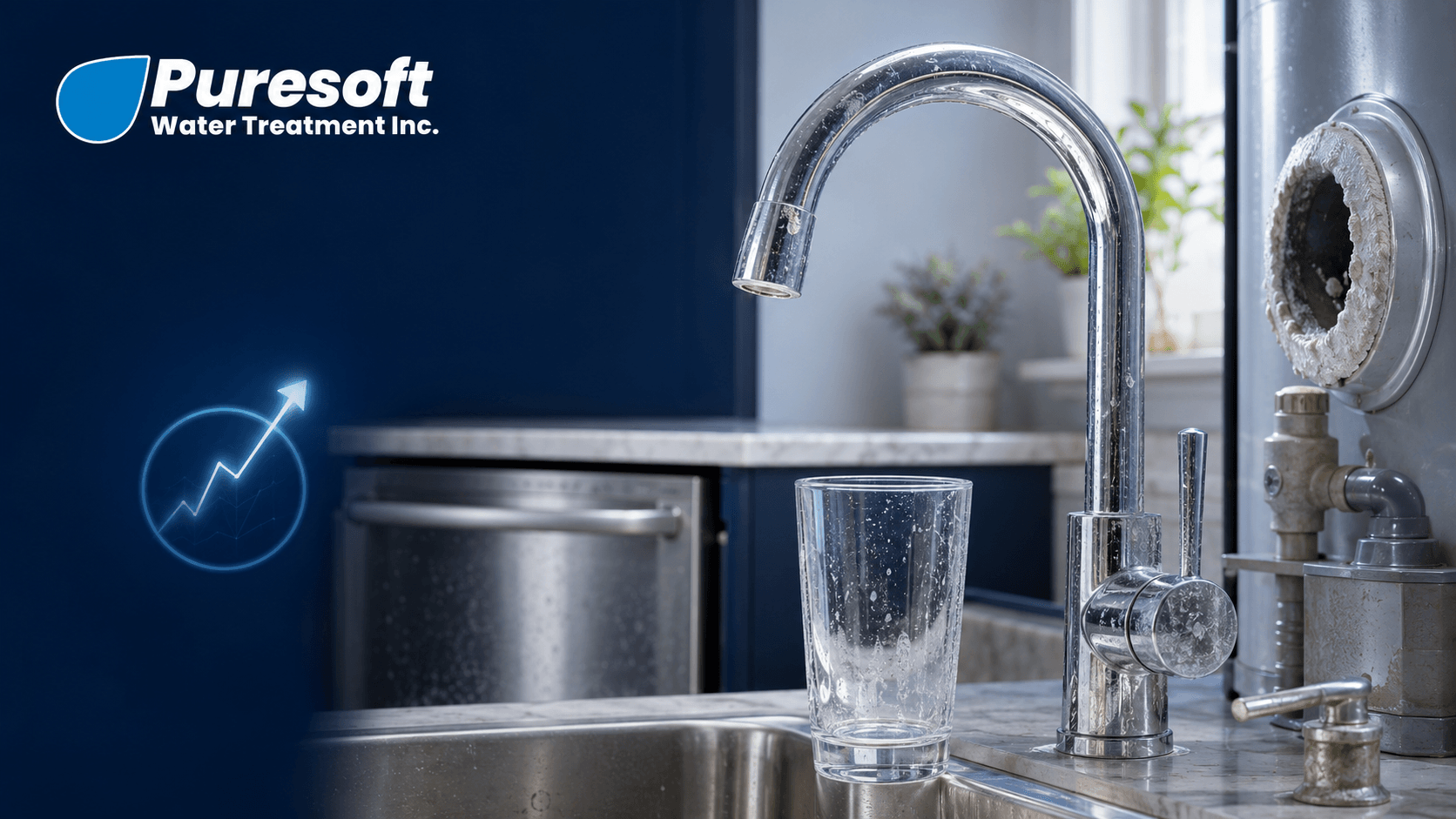
Scale is a slow problem, which is why it is easy to overlook in a new home. Over months and years, it builds up in places you cannot see and shows up in places you can. Hard water commonly affects these parts of a new home in Westfield, Indiana:
- Tank water heaters: Minerals settle at the bottom of the tank and coat heating elements, which reduces efficiency and can shorten the heater's life.
- Tankless water heaters: Scale forms inside the narrow passages of the heat exchanger, restricting flow and reducing performance.
- Glass showers and fixtures: White spots and film build up on glass doors, chrome, and stainless finishes, making them harder to keep looking new.
- Dishwashers and washing machines: Scale coats internal parts and spray arms, and hard water makes detergents less effective.
- Faucet aerators and showerheads: Mineral deposits clog small openings and reduce water flow.
- Plumbing lines: Deposits slowly accumulate inside pipes and valves, especially in hot water lines.
What Is a Softener Loop, and Do Builders Include One?
Many builders in Westfield, Indiana offer or include a softener loop. A softener loop is a plumbing rough-in that routes the main water line to a convenient spot, usually in the garage, basement, or utility room, and provides inlet and outlet connections where a softener can be installed later. Until a softener is connected, a short piece of pipe or a bypass completes the loop so water can flow through.
A loop makes future installation much simpler, but it does not mean your home has a softener. It is also worth checking how the loop was designed. Ideally, outdoor spigots are left off the loop so they receive untreated water, and the location has access to a drain for regeneration wastewater and a nearby electrical outlet.
If your home is still under construction, ask your builder whether a loop is included, where it will be located, and whether a drain and outlet will be available. These details are much easier to address before the drywall goes up than after you move in. For budgeting, see our breakdown of water softener installation costs.
Should You Install a Softener During Construction or After Move-In?
You can add a water softener at either stage, and each path has its own advantages. Here is how the two options compare:
| Factor | During Construction | After Move-In |
|---|---|---|
| Plumbing access | Loop, drain, and outlet are easy to plan | May require rerouting if no loop exists |
| Protection | Fixtures and appliances are protected from day one | Some scale may build up before installation |
| Equipment choice | Builder-selected options may be limited | Full choice of system and installer |
| Sizing | May be chosen before water is tested | Can be sized based on a water test at your home |
| Timing | Tied to the construction schedule | Installed on your own timeline |
What Do Appliance Makers Recommend for Westfield, Indiana Homes?
New appliances come with manuals, and those manuals often include guidance about water quality. Some manufacturers list a recommended maximum water hardness, and some tankless water heater manufacturers address hard water directly in their installation or warranty terms. Reading these documents early helps you avoid surprises if you ever need to make a claim. For homeowners in Westfield, Indiana, it is worth checking the documentation for these appliances:
- Tankless water heaters: Look for hardness limits, recommended treatment, and required maintenance such as periodic descaling.
- Tank water heaters: Check whether flushing schedules or water treatment are recommended to maintain performance.
- Dishwashers: Some models include a setting for water hardness that affects detergent and rinse performance.
- Steam ovens and steam washers: Appliances that create steam are especially prone to mineral buildup.
- Refrigerators with ice makers: Hard water can contribute to scale in water lines and cloudy ice.
Frequently Asked Questions About Water Softeners in New Homes
Will a water softener increase my home's resale value?
It can help, although modestly. A softener is not usually a major line item in an appraisal, but it can be a selling point in areas where hard water is common. Buyers who know about local water often appreciate a well-maintained system, along with the good condition of the fixtures and appliances it has protected.
Can I take my water softener with me if I move?
It is possible, but it usually needs to be spelled out in the purchase agreement, since a plumbed-in softener is often considered part of the home. Moving one also means uninstalling it, capping the plumbing, and reinstalling and reprogramming it at the new home.
Do I need a softener if I already have a whole-house filter?
Most whole-house filters are designed to reduce chlorine, sediment, or specific contaminants, not hardness. Unless the system is specifically designed to soften water, you will likely still have hard water. Many homes use both, with the filter and softener working together.
How much space does a water softener need?
A typical residential softener with a separate brine tank needs a few square feet of floor space, plus clearance for adding salt and servicing the valve. Compact cabinet-style units take up less room but generally hold less salt.
Should my lawn irrigation system use softened water?
No. Irrigation lines are usually connected before the softener so lawns and landscaping receive untreated water. This saves salt and keeps sodium out of the soil. Your installer can confirm how your irrigation supply is connected.
Conclusion
A new home starts with clean plumbing and spotless fixtures, but hard water begins working against them right away. A water softener protects water heaters, appliances, and finishes from scale, and planning for one early, whether through a softener loop during construction or an installation soon after move-in, gives you the most benefit.
Puresoft Water Treatment installs water softeners in new and existing homes across Central Indiana and can test your water to recommend a system sized for your household. If you have recently moved into a new home or are building one, reach out to our team to see what the right setup looks like.
Contact Puresoft Water Treatment